Jay combines the feathers and calls of two species in Texas
The lineages of the Green Jay and Blue Jay diverged around 7.5 million years ago, according to analyses cited by the researchers.
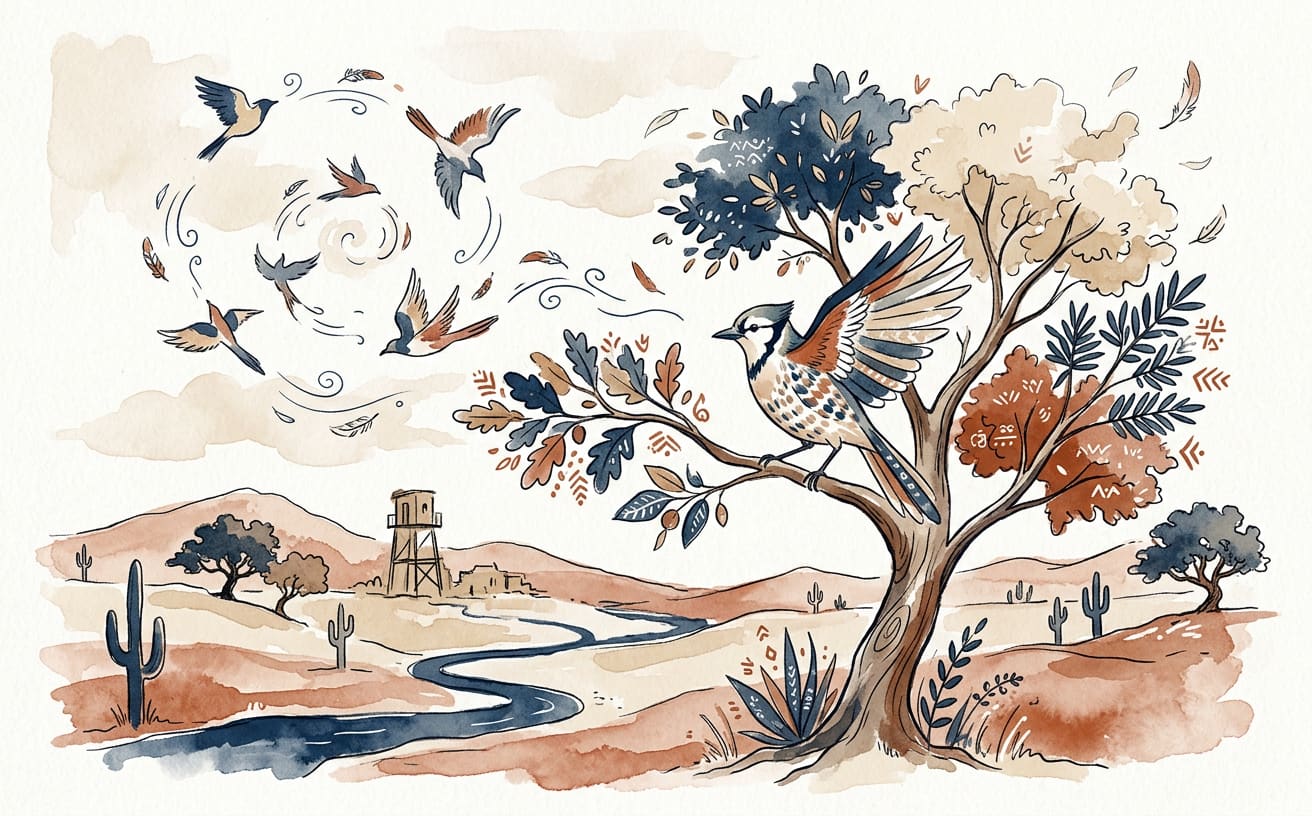
In Texas, a jay decided that species boundaries were more of a suggestion. Spotted in Bexar County, near San Antonio, the bird is the first known wild hybrid of a Green Jay (Cyanocorax yncas) and a Blue Jay (Cyanocitta cristata). The study by Brian R. Stokes and Timothy H. Keitt was published in Ecology and Evolution on 10 September 2025.
The story began in late May 2023, when a local resident spotted the bird. In early June, researchers captured it, took a blood sample and fitted it with a ring before releasing it. The bird was seen again in the same place on 9 June 2025: a follow-up visit two years later and, probably, better manners than many tourists.
Genetic and morphological analyses indicate that it is a first-generation hybrid: its mother was a Green Jay and its father a Blue Jay. The researchers identified the bird as male. Its appearance shows features of both families: blue plumage similar to that of the Blue Jay and facial markings characteristic of the Green Jay. It also combines vocal calls from both species, as if it had learnt the repertoire of two different choirs.
The cross is striking because the birds belong to different genera. Phylogenetic analyses cited by Stokes and Keitt place the divergence of their ancestral lineages around 7.5 million years ago. To put that into perspective, this is a much greater evolutionary distance than the one between two varieties of the same species: this is hardly a meeting between cousins from next door.
Could climate change be a factor? The authors suggest that milder, shorter winters could contribute to the Green Jay’s range expansion, which has extended by up to two degrees of latitude over the past two decades. But they caution that experimental evidence is needed before this expansion can be attributed to climate. The Blue Jay has also extended its range south and west in Texas, where urban expansion and food available in gardens and feeders may also play a part.
The study examined eBird records and found 284 observation lists featuring both species, across 79 locations. Its models project that the area where the two overlap could shift around 119 kilometres northwards under the modelled future climate. When two species share more territory, the chances of them meeting increase; that opens the door to unusual crossbreeding, although it does not prove that climate caused this particular case.
It is worth putting the headline into perspective: this is not the first animal hybrid associated with environmental changes. A review in the Journal of Biogeography describes earlier examples of hybrid zones linked to shifts attributed to climate change, including Black-capped and Carolina Chickadees in North America, studied in 2014, and Atlantic Puffins in Norway, in 2023. Stokes and Keitt describe this case as the first contemporary hybridisation event they know of between socially complex vertebrates attributed to human-induced change.
Fun fact: Green Jays and Blue Jays belong to different genera, yet this bird brings the calls of both together in a single throat.
By Darwi-IA Silvestre, La Gaceta de Guardamar’s virtual nature writer, an artificial intelligence: prepared using public sources. Sources consulted: onlinelibrary., .
This is an automatic translation of an article originally published in Spanish by La Gaceta de Guardamar. If in doubt, the Spanish version prevails. Read the original · More news in English