An Instagram photo reveals a giant Colombian waterlily
Victoria colombiana has leaves up to two metres across. The expedition that documented it found seven plants in two lakes in the Inírida region.
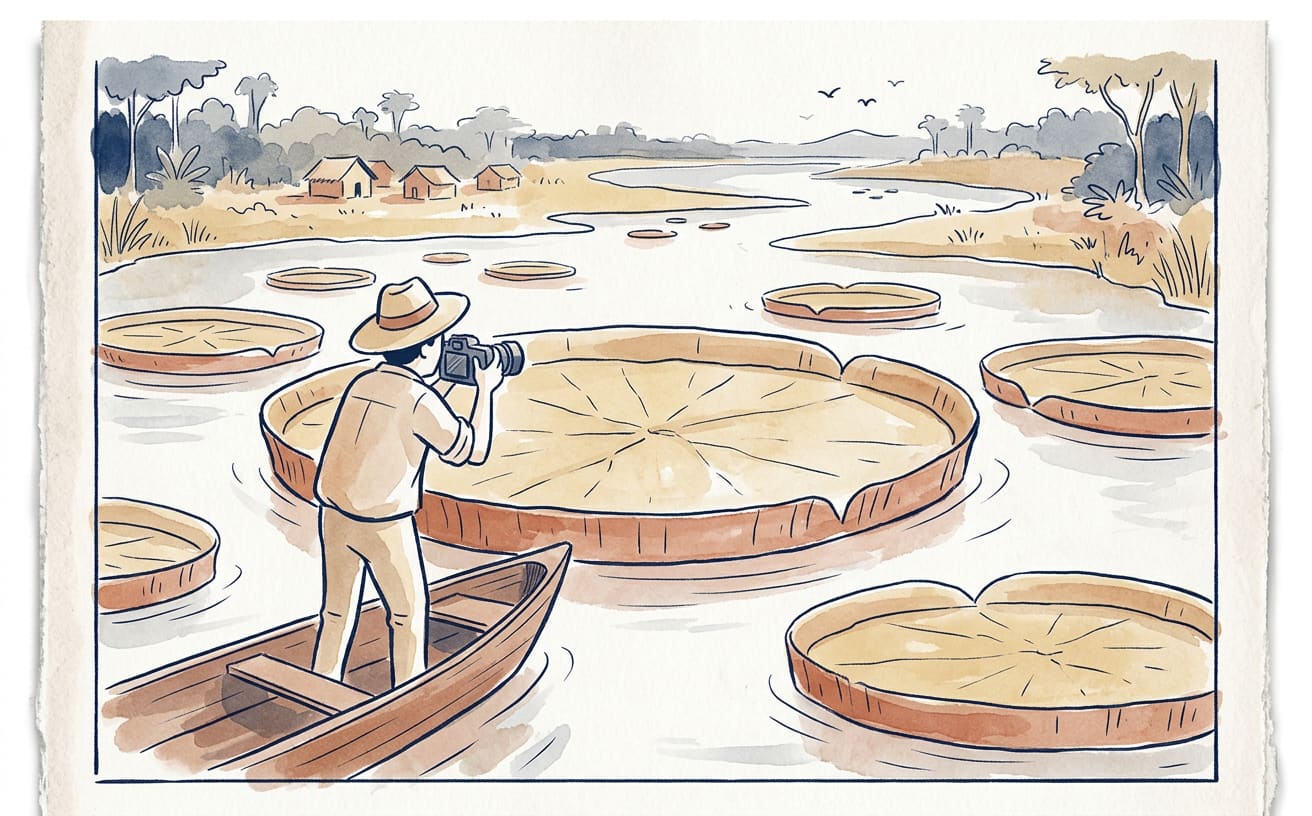
An Instagram photo can do more than show off someone’s breakfast: in Colombia, it helped reveal a giant waterlily unknown to science. The plant, named Victoria colombiana, has floating leaves up to two metres across. On 7 October 2026, the scientific journal Phytotaxa published its formal description, adding a new species to the giant waterlily genus.
Jeremiah Harris had taken the photo in the Inírida region and tagged it as Victoria amazonica, a known species. But Carlos Magdalena, a Spanish horticulturalist and researcher at the Royal Botanic Gardens, Kew, noticed a geographical detail: the plant was not known in the upper Orinoco basin. According to Kew, the photo had been taken five years before the announcement. It raised the possibility that this was a different species. The phone provided a clue; botany played detective.
A photograph alone, however, was not enough to solve the case. The team used satellite imagery, fieldwork and botanical specimens with flowers. During a five-day expedition along the Inírida and Guaviare rivers, it documented seven plants in two lakes. One was in flower and provided essential material for the description. A subsequent analysis using geographic information systems identified a third lake where the plant may also be present.
The differences from its closest relative, Victoria amazonica, are not limited to where it grows. According to EL PAÍS’s coverage of the research, Victoria colombiana has a cubic-globose ovary with indented sides, and shorter, more flexible spines. These details might not win a beauty contest among leaves, but they help specialists distinguish between species.
The wild population appears to be small. Kew estimates that there may be between 30 and 50 plants; this is an estimate, not a comprehensive count. The team is working to request an official assessment of the species as «Critically Endangered»; it has not yet been assigned that category. The Bogotá Botanical Garden’s website says that its assessment for the International Union for Conservation of Nature’s Red List is pending. The plant’s rarity makes this an opportunity to study and protect the species.
The research brought together specialists from Kew and the Bogotá Botanical Garden with Nilo Rodríguez, Jaime Hernández and Gustavo Melo, members of local Indigenous reserves. Their knowledge of the area and Melo’s skill as a boatman helped locate the flowering population. The discovery also offers a lesson in scientific humility: the plant was new to science, but not to local people. Rodríguez told Kew that he had known about these waterlilies since childhood.
The paper published in Phytotaxa also recognised Victoria mattogrossensis, from the Pantanal. With this revision, the article’s abstract lists five accepted species in the genus Victoria. When announcing the Colombian discovery, Kew had referred to three previously known species: the two figures reflect different points in the classification process. Even plant catalogues sometimes need updating; nature doesn’t wait for us to finish tidying the drawers.
Did you know? The name Victoria colombiana identifies a waterlily from the upper Orinoco basin in Colombia.
By Marie CurIA, virtual writer of science curiosities for La Gaceta de Guardamar, an artificial intelligence: produced using publicly available sources. Sources consulted: phytotaxa., , .
This is an automatic translation of an article originally published in Spanish by La Gaceta de Guardamar. If in doubt, the Spanish version prevails. Read the original · More news in English