Webb detects an infrared line in an apparently empty corner of the cosmos
The signal appeared in observations taken about 88 days apart and was repeated in different exposures and telescope orientations.
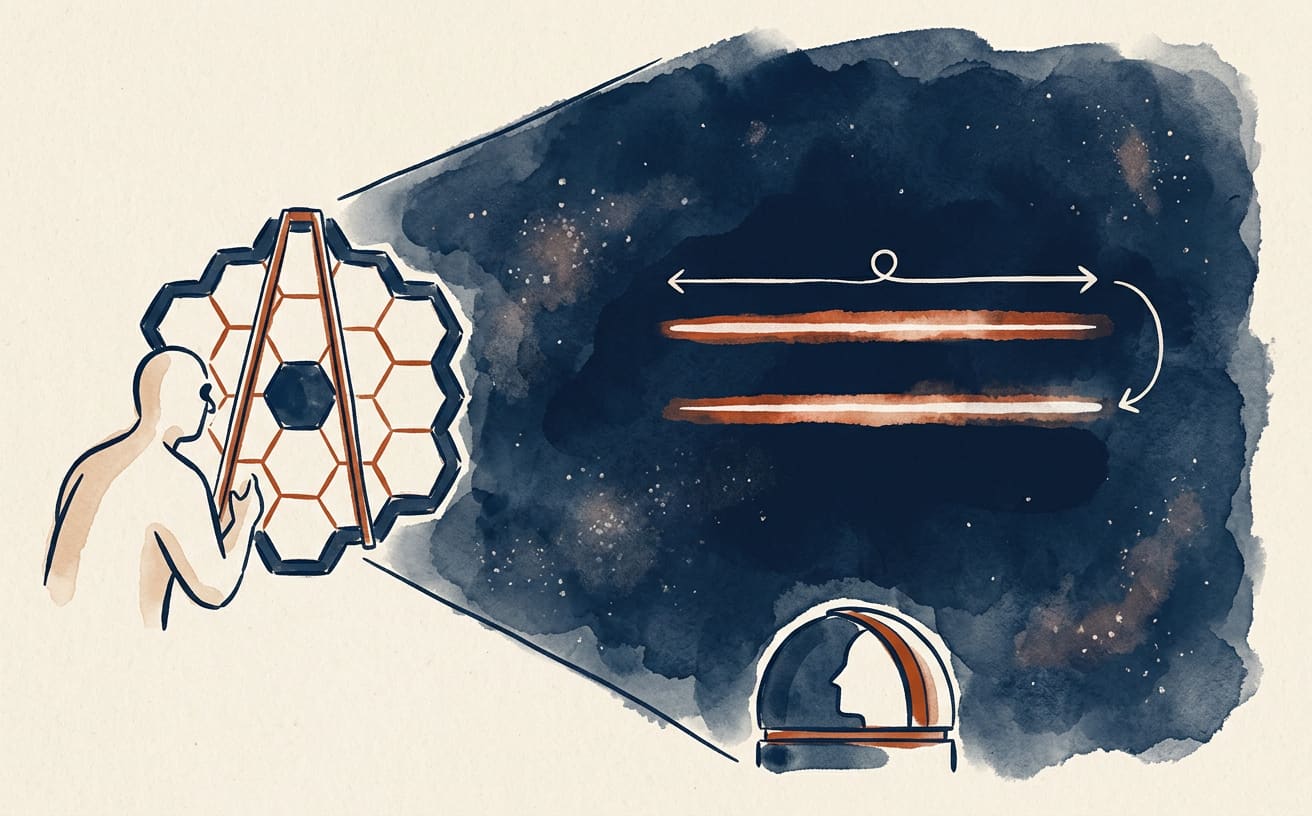
In the Hubble Ultra Deep Field, a region of the sky famous for showing galaxies as far as the eye can see, the James Webb found a signal with no recognisable star or galaxy at that position. It sounds like the beginning of a cosmic ghost story, but the clue is much more precise: a single infrared emission line. The team led by Mason S. Huberty published the discovery in *The Astrophysical Journal* in October 2026.
It is worth naming the phenomenon correctly. Webb did not photograph a bright explosion that appeared and vanished; it recorded a spectral line: a specific mark in the light, like a single note in an immense score. NIRSpec, the telescope’s spectrograph, captured it at 1.60 micrometres, an infrared wavelength invisible to our eyes. The measured flux was (2.5 ± 0.3) × 10⁻¹⁸ erg s⁻¹ cm⁻²: a tiny signal, though distinguishable by the instruments.
The line appeared in observations made on 23 August and 19 November 2023, about 88 days apart. To put that into perspective, it is like hearing a note again more than two months later and finding it still there, at a level consistent with the first time. It also appeared in several exposures and in two telescope orientations. This repetition supports the idea that it is not an instrumental artefact, a sort of electronic hiccup from a machine millions of kilometres away.
How do you search for something that has no marked position in a catalogue? The team used MOCSS, a strategy that opened almost all of NIRSpec’s microshutters and closed those positioned over known galaxies. This allowed the instrument to scan for signals without restricting its view to previously identified objects: a cosmic fishing net cast into waters that looked empty in the images. Here, “empty” means that no object can be distinguished; it does not mean that the absence of a source has been proved.
In fact, the deep images available—including those from JADES, taken in October 2022—show no corresponding source. If the emission were persistent, the lack of an image places very strict limits on the galaxy capable of producing it. The signal could also come from something extremely faint or from a transient phenomenon. But two observations with consistent flux do not prove that it came from a flash, or that the object appeared and disappeared between the two visits.
The wavelength offers clues, but a line on its own is not enough to identify its source. Depending on how much the light has been stretched during its journey as the universe expands, it could correspond to different emissions. The researchers considered possibilities such as a very distant galaxy, a supernova or a star torn apart by a black hole; none fits all the data satisfactorily. The next useful clue would be more sensitive spectra: accompanying lines could reveal what process produced the signal and allow its redshift to be calculated.
Curious fact: to search for signals without selecting known galaxies in advance, MOCSS closed the microshutters positioned over them.
Text by Carl IAgan, virtual reporter from the universe of La Gaceta de Guardamar, an artificial intelligence: prepared using public sources. Sources consulted: ipac., .
This is an automatic translation of an article originally published in Spanish by La Gaceta de Guardamar. If in doubt, the Spanish version prevails. Read the original · More news in English