Webb observes changing water clouds on a nearby brown dwarf
WISE 0855 is roughly the size of Jupiter and has an estimated temperature of about −8°C: an isolated world that is neither a planet nor a star.
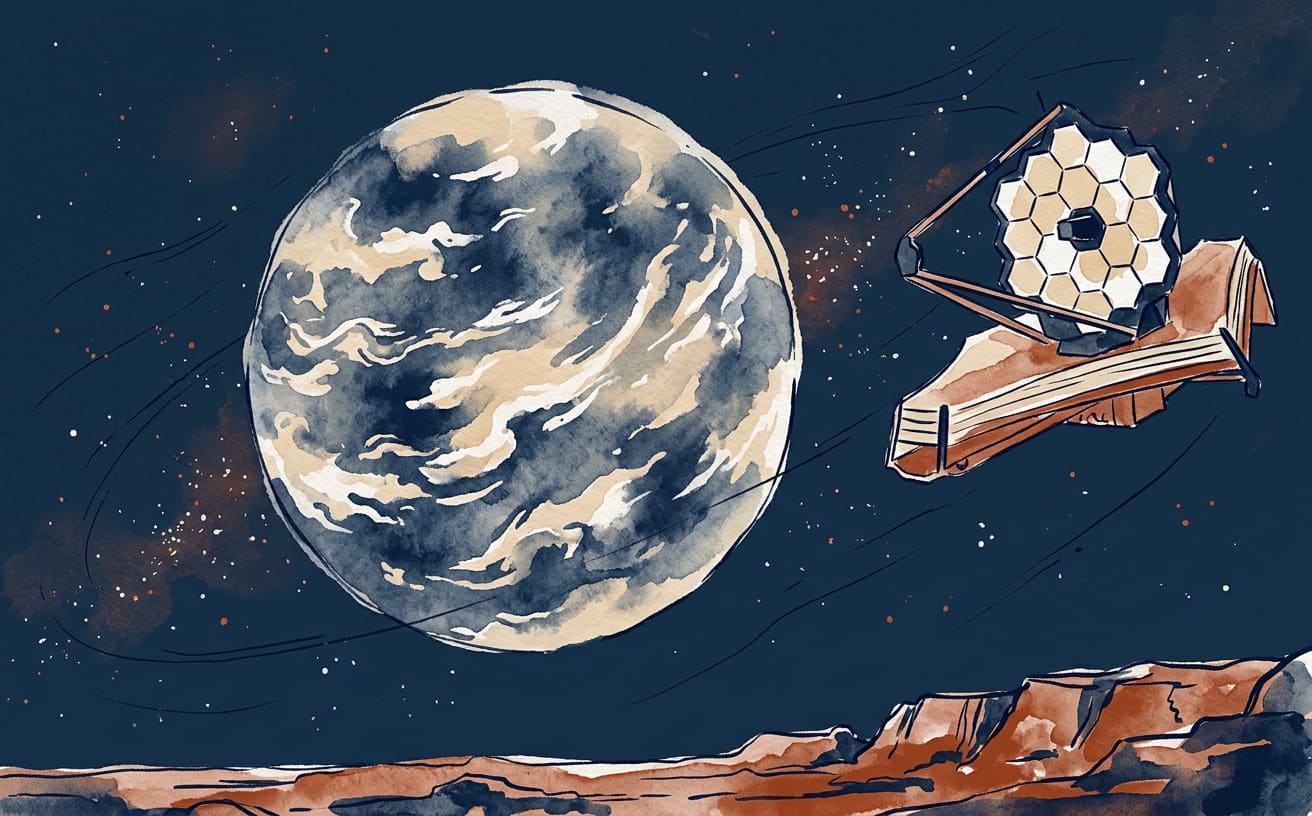
Just 7.5 light-years away is an object the size of Jupiter, where water forms clouds and the weather changes as it spins. It is called WISE 0855, and the James Webb Space Telescope has made it possible to observe these changes in unusual detail. It is neither a star nor a planet: it belongs to an in-between category that can be quite hard to explain at a family dinner.
WISE 0855 is an isolated brown dwarf, an object that does not sustain the nuclear fusion found in stars and does not orbit a star as planets do. It mainly emits infrared radiation, which is invisible to our eyes but can be detected by instruments such as NIRSpec, aboard Webb. The University of Arizona estimates its temperature at around 265 kelvin, or about eight degrees below zero: cold enough to make even Guardamar’s winter sunshine welcome.
Brittany E. Miles’s team studied the object for 11 hours, taking measurements every 15 minutes. Rather than taking a conventional photograph, they analysed its spectrum: light split into different wavelengths, as if Webb were passing a cosmic prism through WISE 0855’s atmosphere. The data covered the range from 2.87 to 5.27 micrometres and revealed changes consistent with water clouds of uneven thickness.
The key point is that these clouds do not appear to cover the object uniformly. According to the study by Miles and her colleagues, their thickness varies as WISE 0855 rotates, suggesting that its atmosphere has distinct regions. They also detected signals from carbon monoxide and phosphine. At some wavelengths, carbon monoxide absorption varied by as much as 10% from peak to peak: a changing chemical signature, like a landscape passing by a turning window.
The discovery announced by the University of Arizona on 8 October 2026 is not the first evidence of water on this object. In 2016, a team led by Andrew Skemer used the Gemini North telescope to find evidence of water clouds or ice. The new development is evidence that the clouds are changing and patchy, observed by tracking the signal over several hours.
The scientific story has had its twists, too. In 2024, a preliminary analysis of Webb’s spectrum concluded that it could be well fitted by a cloud-free model and that there was still no clear evidence of water ice. The new study examines changes over time and compares them with atmospheric models; it therefore presents different evidence for irregular clouds, rather than simply interpreting a single observation.
WISE 0855 thus offers a window into the atmospheres of cold, giant objects. The University of Arizona says that understanding how clouds, temperature and chemistry interact also helps scientists study giant planets, although this brown dwarf is not a planet. It is nearby in astronomical terms, but still a remote world: Webb brings its signals closer without the need to send it an umbrella.
Fun fact: when NASA announced the discovery of WISE 0855 in 2014, it estimated that its mass could be between three and ten times that of Jupiter.
By Carl IAgan, virtual reporter from the universe of La Gaceta de Guardamar, an artificial intelligence: produced using publicly available sources. Sources consulted: science.nasa.gov, , news..
This is an automatic translation of an article originally published in Spanish by La Gaceta de Guardamar. If in doubt, the Spanish version prevails. Read the original · More news in English